





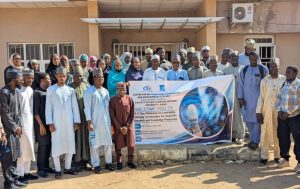
The Centre for Information Technology and Development (CITAD), in collaboration with the Faculty of Life Sciences, Bayero University, Kano (BUK), has trained 41 academic staff members on emerging technologies to enhance scientific research and knowledge production.
The two-day workshop, held from Monday to Tuesday at the Faculty of Life Sciences, focused on the use of digital tools, artificial intelligence (AI) and block chain applications in academic research.
Speaking at the event, CITAD’s Human Resource Officer, Mr Sani Sa’idu Muhammad, said the training was designed to bridge the gap between academic research and societal development.
According to him, emerging technologies now play a critical role in how knowledge is generated, applied and shared.
He said that equipping lecturers with relevant digital skills would have a multiplier effect on students, research institutions and society at large.
The Sub-Dean of the Faculty of Life Sciences, Prof. Hajara Adamu, described the workshop as timely and impactful, noting that it broadened participants’ understanding of how AI and block chain could support scientific research, data management and publication processes.
She commended CITAD for adopting a practical approach that simplified complex digital concepts for academics.
Some participants said the training significantly enhanced their research capabilities.
One of them, Prof. Shamsuddeen Umar, said the practical demonstrations on AI and blockchain would help improve data accuracy and streamline research publication.
Similarly, Fiddausi Ado Dandawaki said the programme exposed participants to digital tools capable of transforming research output and knowledge dissemination.
Another participant, Prof. Abdulkadir M. Magashi, described the workshop as a critical intervention, adding that integrating emerging technologies into teaching and research would improve the quality and international visibility of academic work.
Chairman of the workshop, Prof. Ibrahim L. Abdullahi, said the training boosted participants’ confidence in applying digital tools to teaching and life sciences research.
He noted that although some of the technologies were new to participants, the sessions made them easier to understand and relevant to their work.
Mr Muhammad said the programme aligned with CITAD’s mission of promoting digital literacy, innovation and research integrity through partnerships and capacity-building initiatives.