



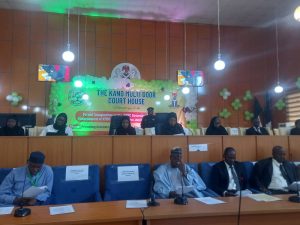
The Chief Judge of Kano State, Justice Dije Aboki, on Monday inaugurated the Governing Council of the Kano Multi-Door Courthouse (KMDC) and signed a new Practice Direction on Restorative Justice to enhance access to justice through Alternative Dispute Resolution (ADR).
Speaking at the ceremony in Kano, Aboki described the development as a significant step toward modernising the justice system, reducing case backlogs and promoting peaceful coexistence through non-adversarial dispute settlement.
She said the KMDC operates under the Kano State Multi-Door Courthouse Law 2022, which provides citizens with multiple dispute resolution mechanisms that are faster and more efficient than conventional litigation.
“The vision for the Kano Multi-Door Courthouse is not merely an alternative, it is an innovative engine driving the future of justice in Kano,” she said.
Aboki explained that the new restorative justice framework would prioritise victims’ rights, offender accountability and the healing of relationships, rather than relying solely on punitive measures.
She added that High Courts, Magistrates’ Courts and Sharia Courts have been authorised to apply restorative processes in suitable cases, especially minor offences, excluding terrorism, kidnapping, sexual offences and capital crimes.
She, however, noted that Islamic principles would guide exceptions in culpable homicide where restitution is acceptable to the victim’s family.
The Chief Judge also disclosed that three ADR judges—Justice Abdu Maulud, Justice Ibrahim Musa Fari and Justice Maryam Sabo—have been appointed to validate mediated agreements and convert them into consent judgments.
She urged judges, magistrates, Sharia court judges and the Nigerian Bar Association to support referrals to the KMDC, stressing that the success of the initiative depends on their collaboration.
Aboki appealed to the state government to provide adequate infrastructure, noting that the centre’s current accommodation within the High Court premises is insufficient.
“It is absolutely necessary that the state government provide the courthouse with a structure of its own, one that aligns with the objective for which the centre was set up,” she said.
Also speaking, the Acting Director of KMDC, Yahaya Muhammad Sani, said the centre was established to enable residents resolve disputes amicably without resorting to the police or conventional courts.
He said once disputing parties reach an agreement, it is forwarded to an ADR judge for endorsement as a consent judgment of the High Court, ensuring speedy and cost-effective justice.