





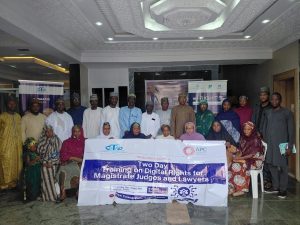
The Centre for Information Technology and Development (CITAD), in collaboration with the Association for Progressive Communications (APC), has concluded a two-day capacity-building programme for 20 legal practitioners from Kano State on emerging issues in digital rights.
The training, held on Thursday and Friday in Kano, brought together 10 lawyers and 10 magistrate court judges to enhance their capacity to interpret and safeguard digital rights within Nigeria’s legal framework.
CITAD’s Digital Rights Officer, Mr Ali Sabo, said at the closing session that the protection of digital rights has become increasingly important amid rising violations by both state and non-state actors.
He said such violations often targeted journalists, dissenting voices and opposition figures, adding that while the Cybercrime Act, 2015 was designed to address cyber-related offences, it had sometimes been used to suppress freedom of expression and online criticism.
Sabo noted that the country’s digital space was also facing challenges such as online gender-based violence, misinformation, fake news and other forms of abuse, some of which had led to loss of lives through suicide.
“Protecting digital rights is inseparable from safeguarding broader human freedoms such as freedom of expression, association, movement and access to information, both online and offline,” he said.
According to him, Nigeria’s rapid move into a technology-driven future, shaped by Artificial Intelligence, the Internet of Things and robotics, made it critical for the judiciary to protect citizens’ rights in the digital environment.
“The right to the internet is no longer a privilege; it is a fundamental right that must be guaranteed to all,” Sabo said.
He also called for more accountability from major technology companies, especially in the Global South, urging stronger legal frameworks to ensure compliance.
Sabo cited ongoing discussions between the Federal Government and Meta, Facebook’s parent company, as an example of the need for such firms to establish a physical presence in Nigeria to enable effective redress when rights were violated.
He said CITAD’s interventions extended beyond public awareness to providing free legal support to victims of digital rights violations, and urged the judiciary to play a more active role in adjudicating such cases to promote a safer and more rights-respecting digital space.