


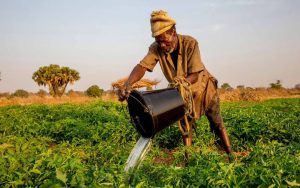
The Kano State Government says it has recovered more than 1,200 acres of irrigation farmland and is developing 11 mini-dams across local government areas to boost agricultural production.
The Commissioner for Agriculture and Natural Resources, Dr Danjuma Mahmoud, disclosed while briefing newsmen on the Ministry’s three years achievements on Tuesday in Kano.
Mahmoud said the state government had also commenced the construction of a major irrigation project at Donsoshia, alongside plans to expand irrigation facilities across the state.
He said the government had completed a 14-kilometre access road to the Donsoshia project site to facilitate the movement of heavy equipment.
According to him, the dam project, designed to provide water for about 500 hectares of irrigation land, is currently 40 per cent complete.
The commissioner said the government had also secured approval for the construction of 11 mini-dams and irrigation facilities in 11 local government areas.
He listed the areas to include Ajingi, Kibiya, Sumaila, Doguwa, Shanono, Dawakin Kudu, Gwarzo, Rogo, Bichi, Dawakin Tofa and Ungogo.
Mahmoud said contractors had mobilised to some of the sites, while compensation payments had been made in six locations to facilitate construction.
He explained that the projects, when completed, would provide about 2,000 additional acres of irrigable farmland, create employment opportunities and reduce rural-urban migration.
The commissioner said the ministry had also established a farmers’ database to provide reliable information for agricultural planning, budgeting and collaboration with development partners.
He said the database had helped the government identify farmers across the state and provide accurate information to support interventions by the Federal Government and other partners.
Mahmoud said the state had also rehabilitated irrigation facilities at major sites, including Jermambaka, Kadawa, Bunkure A and Bunkure B, leading to the recovery of more than 1,200 acres of farmland.
He added that collaboration with the Federal Government and the African Development Bank under the ATAPS project had helped recover an additional 200 acres for irrigation.
On agricultural mechanisation, the commissioner said the government had acquired various farm implements, including tractors, threshers, forklifts, combined harvesters, solar irrigation pumps, planters and transplanters.
He said the government planned to distribute the equipment free of charge to registered and credible farmers’ cooperatives, subject to proper corporate governance and accountability.
According to him, the state is also working with development partners, including the Islamic Development Bank, World Bank and International Fund for Agricultural Development (IFAD), to strengthen agricultural productivity.
He said the interventions had also supported livestock farmers, particularly women and youths, through the distribution of cattle, goats and rams, alongside animal feeds and veterinary drugs.
Mahmoud said more than 7,800 cattle had been provided to beneficiaries under livestock support programmes, while over 13,000 beneficiaries had received livestock-related support.
He said women were particularly targeted under the goat distribution programme, with each beneficiary receiving three goats for breeding, while youths received two rams each for fattening.
The commissioner said the state government, in collaboration with local governments, had procured nearly 700 truckloads of fertiliser over the last three years for distribution to farmers across the 44 local government areas.
He added that the Federal Government had also supplied fertilisers and other agricultural inputs to support farmers in the state.
Mahmoud further disclosed that the government had completed more than 70 milk collection centres to improve milk handling, preservation and marketing among pastoral communities.
He said the centres were equipped with storage facilities and solar-powered cooling systems, adding that milk transportation containers were ready for distribution.
He said the ministry had also completed several agricultural storage and aggregation facilities across local government areas to improve the preservation and marketing of farm produce.
The commissioner said the government had upgraded cattle markets in locations including Dumbulu, Falgore, Gwarzo, Wudil and Lambata, providing them with veterinary clinics, water facilities, solar lighting, drainage systems and livestock loading ramps.
He added that the Dawanau grain market had also been upgraded with improved roads, drainage, water facilities, solar lighting and a police station.
Mahmoud said the state government, in partnership with the Islamic Development Bank, had provided about 72 kilometres of tarred and surface-dressed rural roads to facilitate the evacuation of agricultural produce.
He said the roads covered several farming communities, including Gora, Modugi, Daning, Garko, Danguziri, Wase, Baita, Dugal, Milgoma and Tuyankasari.
On livestock management, the commissioner said the government had demarcated about 1,270 kilometres of cattle routes across the state to reduce conflicts between farmers and herders.
He said the intervention had contributed to reducing clashes between farmers and herders to the barest minimum in the state.
Mahmoud also disclosed that the ministry had trained more than 2,000 agricultural extension workers to strengthen farmers’ access to modern farming techniques and advisory services.
He said the ministry had implemented more than 300 projects, which were scheduled for commissioning soon.
The commissioner reaffirmed the state government’s commitment to expanding irrigation, modernising agriculture, improving livestock production and strengthening food security.