




By Rabi’u Isma’il
In politics generally, but especially Nigerian politics, promises are the cheapest oxygen of electioneering. The people are regalled with stories of how the aspirant will turn deserts into sprawling greelands in weeks after election.
However, more often than not, these promises vanish into thin air, immediately mandates have been secured. Governance becomes where rhetoric goes to die naturally.
Across Nigeria, campaign speeches are often replete with polished, poetic rhetoric, but painfully short on delivery. Grand declarations are made with fanfare, manifestoes are unveiled with solemnity, and citizens are painted a very radiant picture of the future.
Unfortunately, it dissolves into familiar darkness shortly after inauguration. That reality perhaps explains why many Nigerians have grown increasingly cynical of political leadership. They have heard too much and seen too little.
But, for the fortitude of some leaders, who every once in a while, emerge to radically attempt to narrow the stubborn distance between promise and performance, Nigerians would have completely lost faith.
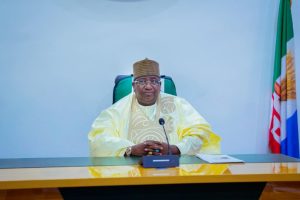
One such rare breeds of leaders is Comrade Governor Nasir Idris, Kauran Gwandu. Three years after assuming office as Governor of Kebbi State on May 29, 2023, Kauran Gwandu, appears determined to protect his reputation as a disruptor, building his administration around a simple but rare belief that government must work, and governance must be felt. To Kauran Gwandu, promises made even at the heat of campaigns are a sacred bond that binds to the people.
Kaura sees fidelity to promise as the true test of leadership, and not meaningless speeches that many politicians favour.
Gov. Nasir believes that every time you have to explain to the people that you are building roads or hospitals, or schools, then you have failed. Real impact is seen and felt in the many roads that have made travel smooth and enjoyable, in the hospitals functioning with new workers, in the smiles of civil servants not owed salaries, in the happy faces of children learning in conducive environments, and many more. These are the hallmark of a responsive government working assiduously to restore the confidence of the common man on democracy.
Perhaps one of the easiest ways to understand the Nasir Idris administration is to look at the physical transformation quietly reshaping the sprawling landscape of Kebbi state.
From Birnin Kebbi to Ambursa, to Argungu and so many other communities, township roads and urban renewal projects, Kebbi has witnessed a deliberate attempt at redefining public spaces and improving mobility.
Birnin Kebbi, in particular, now bears visible signs of renewed planning. Solar-powered streetlights illuminate strategic areas, major roundabouts have undergone beautification, drainage systems are being expanded, and roads once neglected now serve as arteries of movement and commerce.
Naturally, improved infrastructure comes with lots of good things. When public spaces become safer, cleaner, and more accessible, commerce deepens, nightlife expands, insecurity contracts, and citizens gradually begin to feel that governance exists beyond rhetorics. The completion of the ultra-modern Bola Ahmed Tinubu Secretariat Complex at Gwadangaji perhaps stands as one of the administration’s most symbolic achievements.
Beyond brick and mortar, it signals an effort to create institutional efficiency and restore dignity to public administration. Civil servants, long accustomed to poor working conditions in many states, now operate within a more conducive environment.
And speaking of civil servants, one area where Governor Idris appears to have shown uncommon sensitivity is workers’ welfare. It is difficult to overstate the importance of a motivated workforce in governance. Governments do not function through intentions alone; they function through people.
A demoralised civil service almost always translates to poor service delivery. Recognising this, the administration has maintained regular salary payments, implemented the new ₦75,000 minimum wage, and cleared significant backlogs relating to pensions, gratuities, death benefits, and inherited liabilities. For thousands of workers and retirees, this translates into dignity restored.
In a country where delayed salaries have become normalised in some subnational governments, prompt remuneration sends a powerful signal that labour matters, and workers deserve certainty.
Equally significant is the administration’s elimination of casualisation in the civil service, alongside housing interventions and sustained capacity-building programmes designed to improve efficiency and professionalism.
Yet governance is not sustained by salaries alone; it survives on social investment, and few sectors reveal the moral priorities of a government more clearly than healthcare and education. Governor Nasir Idris assumed office with an obvious understanding that public trust in government hospitals had significantly weakened over the years, largely due to inadequate facilities, poor staffing, and uneven access.
The response has been deliberate. General hospitals, dispensaries, and primary healthcare centres across the state have undergone revitalisation and upgrading. More importantly, over 2,000 health personnel, including doctors, nurses, and allied professionals, have been recruited to address manpower shortages.
The establishment of the college of nursing and Midwifery is a deliberate investment to forestall the shortage of health personnel.
The procurement of ambulances and modern medical equipment, alongside expanded health insurance enrolment for vulnerable citizens, speaks to a government attempting to move healthcare from aspiration to access. No serious society develops while its citizens die from preventable causes or travel impossible distances to seek routine medical care. The gradual rebuilding of healthcare confidence in Kebbi therefore deserves recognition.
Education tells an equally compelling story. It is perhaps unsurprising that Governor Idris, himself a former classroom teacher and union president, would accord serious attention to the sector, though what matters ultimately is not his history as a teacher, but action.
The recruitment of over 2,000 teachers to address manpower shortages, renovation of schools, provision of learning furniture, and construction of mega schools across major emirates reflect a seriousness that extends beyond inherited nostalgia from days of agitations as a union leader.
More notably, Kebbi state’s decision to sustain payment of examination fees for WAEC, NECO, NABTEB, and NBAIS students offers practical relief to thousands of families already burdened by economic hardship. This is commendable considering the time we are in, where educational access increasingly risks becoming the privilege of the economically fortunate.
Then there is agriculture, arguably Kebbi state’s economic heartbeat. For a predominantly agrarian state, food security cannot remain a theoretical policy ambition; it must be operational. Under the Kauran Gwandu Agricultural Development Agenda, fertilizers, improved seeds, and agro-inputs have been distributed to hundreds of thousands of farmers, while irrigation support systems, including solar-powered pumps and mechanised innovations, continue to expand farming opportunities.
The administration’s response to flooding through residual moisture crop production also demonstrates adaptive governance — the capacity to turn crisis into opportunity. Rather than allowing ecological setbacks to become permanent setbacks for livelihoods, government intervention sought to transform flood-affected areas into productive agricultural zones, attracting wider recognition.
Security, however, remains the lens through which every developmental claim must ultimately be judged. Roads mean little where movement is unsafe, farms become meaningless where farmers cannot cultivate, and schools cannot function where fear dominates communities.
Kebbi, like much of northern Nigeria, has not been insulated from insecurity. Banditry and violent criminality have tested state resilience. Yet Governor Idris appears to have adopted a pragmatic rather than performative approach.
From logistics support to security agencies and vigilante groups, to the deployment of patrol vehicles, motorcycles, operational materials, and community-based security collaboration, the administration has sought to build layered responses to insecurity. Perhaps the strongest evidence of relative progress lies in the return of farmers to lands once abandoned due to fear.
When citizens begin reclaiming spaces insecurity had stolen, government intervention is beginning to register. Importantly too, Governor Idris has repeatedly shown physical presence in troubled communities, offering relief, solidarity, and reassurance. This solidarity may be dismissed as symbolic.
However, during moments of public trauma, the face of a governor, walking through pain with those affected by unfortunate events is, in most cases, is all the assurance they need that he’s fighting with them and for them. Citizens often remember not merely what government says, but whether government showed up. Kauran Gwandu embodies these qualities of a compassionate leader.
Women and social welfare interventions also deserve mention. Skills acquisition programmes, youth empowerment schemes, social welfare support for vulnerable children, and the continuation of mass wedding initiatives for less privileged citizens reflect an administration attempting to preserve social stability while promoting economic inclusion.
Critics may dismiss some of these interventions as politically attractive welfare programmes, but governance, especially in fragile socio-economic contexts, must often balance long-term development with immediate human needs. A hungry society rarely waits patiently for macroeconomic theory.
None of this is to suggest that Kebbi has arrived at perfection. No government around the globe can arrive at perfection. Development is always unfinished business, and citizens retain every right to demand more, question priorities, and insist on accountability. Roads still require expansion, healthcare gaps remain, education quality must deepen beyond infrastructure, and security gains require constant vigilance. But governance should be judged not by utopian standards, but by movement, direction, and measurable effort.
On that score, Governor Nasir Idris’ first three years suggest a leadership attempting, with visible intentionality, to honour the social contract between government and governed.
Perhaps this explains why traditional institutions across Nigeria and beyond continue to honour him with titles and recognition. Yet titles alone do not sustain public legitimacy; performance does. Three years on, the defining argument in favour of Governor Idris may simply be that Kebbi is not standing still.
In a political culture where citizens are too often asked to survive on promises, the Kebbi experience under Nasir Idris increasingly presents a different proposition, it insists that governance, when pursued with sincerity, can still wear the face of fidelity to promise.
Rabi’u writes from Birnin Kebbi