





By Nabilu Balarabe
For many mothers in Yobe, the struggle to access nutritious food and healthcare to protect their children from malnutrition remains a daily challenge.
Poverty, food insecurity, poor sanitation and limited access to essential health services have continued to expose vulnerable families, particularly women and children, to serious health risks.
However, interventions under the Multisectoral Integrated Nutrition Action (MINA) project are providing support to vulnerable households and strengthening community efforts to prevent and manage malnutrition.
Funded by the United Kingdom through its Foreign, Commonwealth and Development Office (FCDO), the project was introduced by UNICEF in March 2023 to improve access to integrated nutrition, healthcare, sanitation and child-protection services in Borno and Yobe.
The initiative was initially designed to operate in 21 local government areas across the two states, with a focus on empowering mothers and caregivers to improve child-feeding practices, identify malnutrition early and access appropriate treatment.
The emotional story of Fatima Mohammed, a mother in Yobe, whose 18-month-old daughter, Aisha, suffered from severe acute malnutrition remains fresh in mind.
Aisha became extremely weak, struggled to sleep, eat and required specialised nutritional treatment.
After being admitted into Nahuta Primary Health Care Centre (PHCC) in Damaturu, she received ready-to-use therapeutic food (RUTF), a specialised nutritional product used in treating severe acute malnutrition.
Mohammed noticed significant improvements in the child’s strength, appetite and ability to play following the treatment.
She explained how the experience changed her understanding of child nutrition, food preparation and personal hygiene and began maintaining a small vegetable garden and adopting improved food-handling and hand washing practices.
Mohammed’s experience demonstrates the importance of combining treatment with nutrition education and behavioural change at household level.
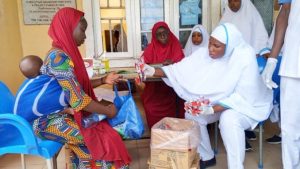
During a recent UNICEF-facilitated media field trip to Mairi PHCC, Damaturu, Salamatu Mohammad, another mother of three, recounted how her baby, Farida, recovered from malnutrition through the support of MINA.
Mohammed said the journey began when she realised she did not have enough milk to breastfeed Farida, a situation that prompted her to take the child to the clinic for proper attention.
Mohammed further stated that Farida was immediately put on RUTF by the facility and in no time, improvement was recorded in her condition.
She commended UNICEF, Yobe government and other development partners for the provision of RUTF and other services, which were free and easily accessible at the facility.
At Maisandari PHCC, Amina Sale, another mother, noted that it was her second visit to the facility to collect RUTF for her malnourished child.
She explained that when she first administered the food supplement to her baby, she noticed some symptoms, including diarrhoea and eye problems.
According to her, the child’s health condition began to improve significantly thereafter as the treatment progressed.
UNICEF and other development partners have continued to build capacity of health workers at primary healthcare facilities to identify malnourished children and help them.
Aisha Suleiman Baba, a Healthcare manager at the Maisandari PHCC, said community mobilisation and screening exercises were used to identify children with Severe Acute Malnutrition (SAM).
According to her, children with Moderate Acute Malnutrition (MAM) are billed for referral and treatment.
She noted that the facility was treating between 50 and 60 children daily, especially during the rainy season, when food shortages usually worsen.
The Nutrition Focal Person, Damaturu Local Government Area, Mrs Zubaida Ahmed, said hundreds of kids and caregivers were visiting facilities across the area daily to access counselling and treatment for malnutrition.
She noted that through the programme, children between six months and five years were accessing health care across the area, especially for Severe Acute Malnutrition.
The official advised mothers to always visit nearby facilities to access the treatment, but warned that selling RUTF by any mother was a serious offence and would not be tolerated.
But despite the enormous progress recorded by MINA in Borno and Yobe, the nutrition situation in north-eastern Nigeria still remains concerning.
At a recent MINA media dialogue in Damaturu, UNICEF Nutrition Specialist, Dr Kelechi Nwogu, said over 900,000 children in Yobe were projected to suffer acute malnutrition, including more than 350,000 severe cases.
“ Behind these figures are children whose survival and development are at risk, and families struggling with conflict, displacement, poverty and food insecurity,” he said.
The specialist, however, said through the project’s preventive nutrition intervention, more than 5 million doses of vitamin A were delivered to children under the age of five.
“ 778, 225 pregnant and lactating mothers benefitted from infant and young child feeding counselling.
“ In addition, 742,170 mothers and caregivers have been trained to conduct weekly Mid-Upper Arm Circumference (MUAC) screening of their children aged 0-5 years, enabling early referral of children at risk of malnutrition.
“ Approximately, 368, 665 children suffering from severe acute malnutrition have received treatment, supported by the procurement of 277, 601 cartons of RUTF,” he said.
To address the gap, Nwogu said MINA was initially designed to be implemented in two phases from October 2022 to March 2025 and April 2025 to March 2027, covering 21 local government areas. 11 local government areas in Borno and 10 in Yobe.
Beyond the direct nutrition intervention, Nwogu said MINA had strengthened the treatment of severe acute malnutrition and contributed to broader health improvement, women empowerment and essential services.
The expert said a total of 1,067, 865 children under 24 months were vaccinated against measles 1 through routine immunisation.
For many low-income families, the inability to afford diverse and nutritious food contributes to poor dietary practices, particularly among pregnant women, breastfeeding mothers and children under two years.
The MINA intervention, therefore, incorporated cash-transfer support to help vulnerable women improve household food choices.
The UNICEF Chief of Borno Field Office, Mr Francis Butichi, said 14,117 vulnerable women in Yobe State benefited from cash transfers intended to improve household dietary choices and child nutrition.
He noted that the intervention was particularly important because improving nutrition required more than providing information about healthy diets as families must have the financial capacity to obtain nutritious food.
Butichi disclosed that MINA nutrition and health interventions were implemented on about 219, 677 new Severe and Acute Malnutrition (SAM) admissions through outpatient and impatient treatments.
Highlighting the multifaceted impact of MINA, the field officer said between October 2023 and March 2026, 1,220 communities were certified as Open Defecation Free (ODF) in Borno and Yobe through the project.
As MINA winds-down, stakeholders have acknowledged its impact and are calling for its sustainability.
Mr Ibrahim Maikasuwa, Director, Community and Family Health Services, Yobe Primary Health Care Board, said the state had adequate arrangement to sustain the programme even after the withdrawal of international donors.
He said the board requested the state government to absorb community mobilisers into the state civil service to support plan to sustain the all-important programme.
Maikasuwa said part of the reasons for the success of the programme was a proactive measure put in place by the board to tackle diversion of RUTF by some unpatriotic civil servants.
The director announced that a PHCC Coordinator in the state was recently sacked after he was found involved in RUTF racketeering.
The relationship between sanitation and nutrition is an important aspect of the MINA approach.
Poor sanitation, unsafe water and inadequate hygiene expose children to infections and diseases that can contribute to malnutrition.
Consequently, MINA has supported community mobilisation and sanitation initiatives aimed at improving hygiene practices and reducing open defecation.
In conclusion, stakeholders’ projection underscores the continuing threat of children’s vulnerability in the North-east region and the need for sustained investment in nutrition services to arrest the situation.
They, therefore, recommend that government and development partners should strengthen collaboration in addressing the issues of affordability and availability of nutritious food, access to health facilities and clean water.
There is also a need to ensure that women in remote communities, persons with disabilities and others vulnerable households are not excluded from essential services.
The experiences of women such as Fatima demonstrate that timely nutritional treatment, practical education and household-level support can make a meaningful difference in the lives of vulnerable children.
Nabilu Balarabe writes from Damaturu.