





By Lamara Garba Azare
Some names are written into history because of courage, sacrifice and service to humanity. Others become forever associated with suffering, destruction and the darkest chapters of human history. Ratko Mladić belongs to the latter category.
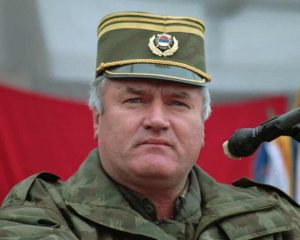
The bull necked Bosnian Serb general, remembered across much of the world as the “Butcher of Bosnia”, died on Thursday, 27 August 2026, at the age of 84 while serving a life sentence in United Nations custody in The Hague. His death closes the physical life of one of the most notorious military commanders of the Bosnian War, but it does not close the history of the crimes for which he was convicted.
Born in 1942, Mladić rose through the Yugoslav military establishment before becoming Commander of the Army of Republika Srpska during the Bosnian War of 1992 to 1995. Under his command, Bosnian Serb forces pursued a campaign of territorial conquest, persecution and ethnic cleansing against Bosnian Muslims, Croats and other non Serbs.
“Ethnic cleansing” became a chilling euphemism for a campaign marked by killings, forced displacement, detention, persecution and the destruction of communities. Behind those words were ordinary human beings driven from their homes, families torn apart and thousands of lives extinguished.
For Mladić and the nationalist project he served, the violence was presented as part of a historic struggle for territory and the creation of what became known as Greater Serbia. The pursuit of that objective transformed Bosnia and Herzegovina into a landscape of fear and suffering.
International justice would ultimately determine that Mladić played a central role in a criminal campaign involving genocide, persecution, extermination, murder, deportation and other crimes against humanity.
His fanaticism was fuelled by a narrative of fear. He portrayed Bosnian Muslims as an existential threat to Serbs, helping to turn neighbours into enemies and communities that had lived alongside one another into targets of suspicion and hatred.
As the war intensified, Sarajevo became one of the most enduring symbols of the brutality of the conflict. For almost four years, the city was subjected to bombardment and sniper fire by Bosnian Serb forces.
Civilians were killed and wounded as the city endured one of the longest sieges in modern European history. Ordinary people trying to live, work, attend school or obtain food and water were exposed to constant danger.
The siege demonstrated the terrifying consequences of Mladić’s command: civilian suffering became a weapon through which an entire population was terrorised.
Yet nothing defines his place in history more profoundly than Srebrenica.
In July 1995, Bosnian Serb forces overran the United Nations designated safe area of Srebrenica, where thousands of Bosnian Muslims had sought protection. Mladić appeared before frightened civilians, projecting an image of reassurance. What followed became one of the darkest episodes in Europe since the Second World War.
More than 8,000 Bosniak Muslim men and boys were killed in the days that followed. Their bodies were buried in mass graves, while efforts were later made to conceal evidence by moving remains from some graves to secondary locations. International courts determined that the Srebrenica killings constituted genocide.
The horror was not simply the number of lives destroyed. It was the deliberate organisation of the killings, the separation of families, the betrayal of those who believed they were under international protection and the systematic destruction of a community.
It was a crime that stripped away every pretence of military honour.
What makes Mladić’s legacy particularly disturbing was his apparent lack of remorse. Even when eventually brought before the court in The Hague, he remained defiant, rejecting the authority of the tribunal and continuing to present himself as a defender of his people.
To some Serbian nationalists, he remained a hero. To the victims of his forces, survivors and international justice, he became something entirely different: a symbol of the catastrophic consequences of nationalism transformed into violence.
That contradiction remains one of the most troubling aspects of his legacy. How can a man celebrated by some as a defender of his people simultaneously be remembered by others as the commander associated with some of the worst crimes committed on European soil in generations?
The answer lies in the difference between propaganda and historical record.
On 22 November 2017, the International Criminal Tribunal for the former Yugoslavia sentenced Mladić to life imprisonment after convicting him of genocide, crimes against humanity and war crimes. In 2021, the appeals chamber upheld his convictions and life sentence.
Thus, after years of hiding, arrest, trial and imprisonment, Ratko Mladić died behind the walls of a prison hospital in The Hague.
The man who once commanded armies ended his life as a convicted war criminal.
The general who once possessed enormous power could not command history to forget.
Mladić’s life offers one of history’s starkest warnings about what happens when hatred is organised, armed and given authority. He demonstrated how military power can become an instrument of persecution when human life is subordinated to ideology. He showed how propaganda can transform neighbours into enemies and how the language of national destiny can be manipulated to justify the destruction of homes, communities and lives.
Military rank does not confer moral greatness.
A uniform cannot make cruelty noble.
A battlefield victory cannot turn genocide into heroism.
And the passage of time cannot cleanse the record of atrocity.
His death therefore should not be remembered as the end of the story. The real story belongs to the victims.
It belongs to the families who waited for fathers and sons who never returned. It belongs to mothers who buried children. It belongs to survivors who carried memories that no prison sentence could erase. It belongs to Srebrenica, Sarajevo and the countless communities whose lives were shattered during the Bosnian War.
Mladić is gone, but the graves remain.
The memories remain.
The testimonies remain.
And the historical record remains.
Those who wield power through terror may imagine that their authority will last forever. They may believe that fear will silence their victims and that time will bury their crimes. But history has another function. It exposes. It remembers. It judges.
Ratko Mladić died at 84, far removed from the power and command that once surrounded him, carrying the historical weight of convictions for genocide, crimes against humanity and war crimes.
May his death remind humanity that no political ambition, ethnic grievance or military command can ever justify the deliberate destruction of innocent human lives.
May Srebrenica never be forgotten.
May Sarajevo never be forgotten.
May the victims never be forgotten.
And may the world remember Ratko Mladić not as a hero or a symbol of military greatness, but as a warning from history: when hatred is given power and cruelty is mistaken for strength, humanity itself becomes the casualty.
His life has ended.
But the testimony of his victims must never end.
Their memory must outlive him.
And the truth must remain buried nowhere.
Lamara Garba Azare, a veteran journalist, writes from Kano